Tinted, Textured, Tested: The Great Facade Divide Reshaping Britain's Towers
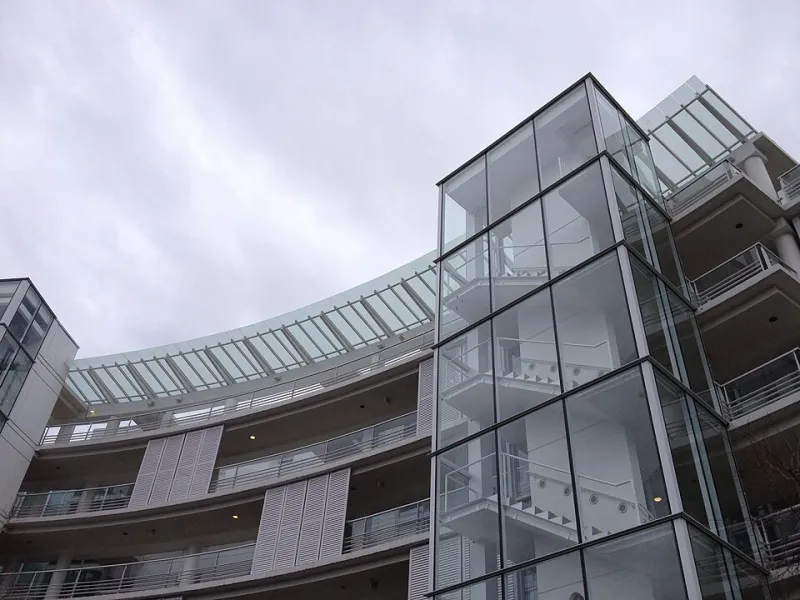
Photo: Wiki.cullin, CC0, via Wikimedia Commons
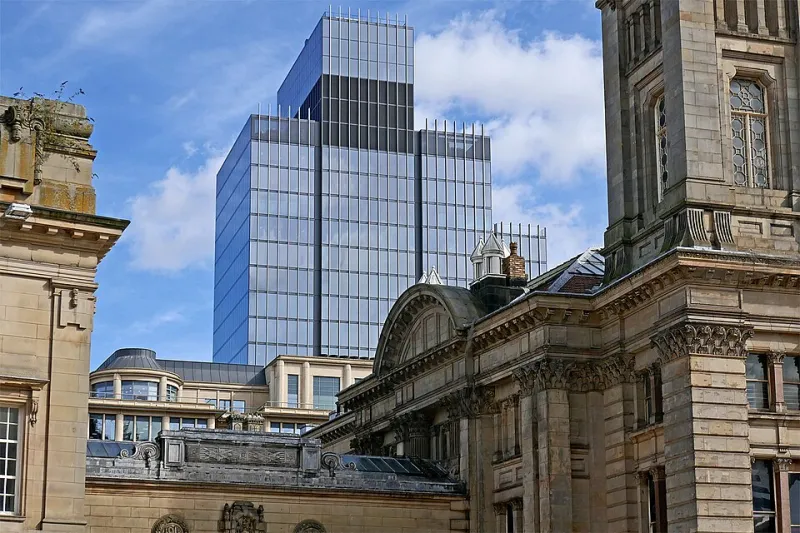
Stand at the foot of a recently completed British tower and you can usually guess its planning history before you read a single committee minute. If the thing glitters — floor-to-floor glazing from pavement to parapet — the odds are it secured consent in the mid-2010s, when the glass box was still the default language of ambition. If, however, the elevations are a considered weave of metal spandrels, bronze anodising and brick-effect panels, you are almost certainly looking at a scheme that went through committee after 2019.
The split is no longer subtle. It has become the defining visual argument of the current generation of British high-rise.
The Glass Retreat
The curtain wall was never merely a fashion. It offered developers speed of erection, maximised net lettable area and projected an international sheen that marketing suites traded on heavily. But the pure glass box has fallen out of favour with almost everyone who matters.
Planners in Leeds have been among the most forthright. Officers there have repeatedly pushed back on schemes where glazing-to-solid ratios were judged excessive for the city's context, nudging applicants toward more articulated elevations with visible depth and material variation. Manchester, likewise, has grown wary of the featureless tower; the city's design panel has consistently pressed for facades that read as buildings rather than mirrors.
In London, the shift has been even more pronounced. Borough design review panels increasingly treat undifferentiated glazing as a failure of architectural thinking, and applications featuring entirely glazed elevations on principal frontages are now routinely asked to justify themselves — often unsuccessfully.
The Regulatory Squeeze
Beneath the aesthetics sits something harder-edged: Part L of the Building Regulations and the broader trajectory toward net zero. A fully glazed facade is, thermally speaking, a difficult object to defend. Even with high-performance coatings and triple-glazed units, the U-values and solar gain figures of an all-glass elevation struggle to compete with a well-detailed wall-to-window composition.
Developers have done the arithmetic. Overheating assessments, once a box-ticking exercise, now carry real weight, and a south-facing glass elevation can add costly brise-soleil, enhanced coatings or mechanical cooling to a budget. A facade with a generous proportion of solid, insulated spandrel does much of that work for free — while offering the bonus of visual texture that planners now expect.
The result is a quiet migration of specification. Bronze-toned aluminium, terracotta baguettes, and brick-slip systems over insulated backing are appearing on towers from Salford Quays to Croydon, chosen as much for their thermal performance as their warmth on the eye.
Two Camps, Two Philosophies
It would be too neat to say the glass tower is dead — the recent completions clustered around Bank and Bishopsgate in the City demonstrate that the mirrored monolith retains institutional backing where lettings are strong and the planning context permissive. These buildings sell themselves as timeless capital assets, their facades a function of the global office market rather than local sentiment.
The second camp is more conversational. Towers such as those rising across Manchester's Deansgate square-mile and Leeds' South Bank increasingly wear their materials as a gesture toward neighbourhood: brick tones echoing warehouse heritage, metalwork picking up the colour of Victorian ironwork, elevations stepped and modelled to give the street something to look at. The residential-led tower, in particular, has embraced this register — buyers, it turns out, respond to warmth.
The divide, then, is not simply aesthetic but typological. Glass still rules where commercial floorspace dominates; the toned and textured facade dominates where homes do.
What to Watch
For skyline watchers, the consequence is a British high-rise scene that is becoming visibly more varied — and, arguably, more interesting. The era in which every new cluster looked like a shipment of imported green glass has ended. In its place: a generation of towers that wear their context on their sleeves, and a smaller, more defiant camp of glass boxes holding the line in the financial cores.
Whether the pendulum swings back once energy targets settle — or facade technology renders the debate moot — remains to be seen. For now, the elevations tell the story.