Frozen Mid-Rise: The Concrete Skeletons Britain Forgot to Finish
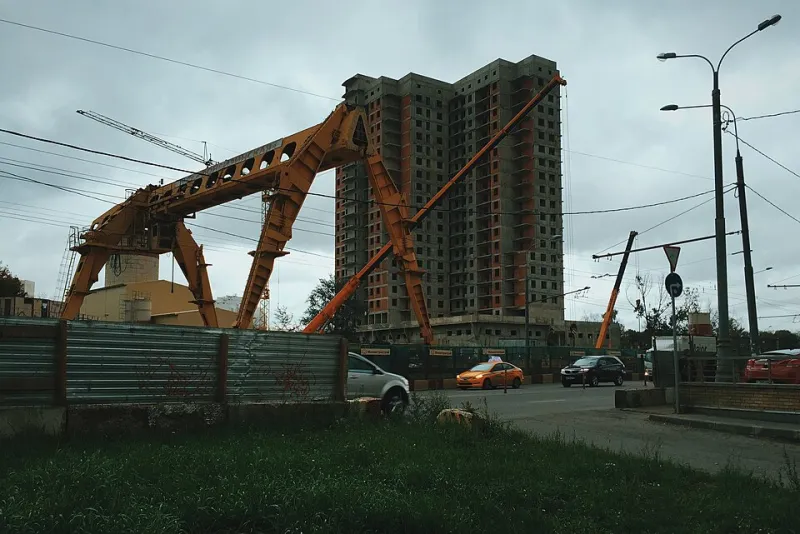
Photo: Gennady Grachev from Moscow, Russia, CC BY 2.0, via Wikimedia Commons
Every skyline has its finished towers, its hoardings promising what comes next — and, less glamorously, its orphans. The half-built frames that linger for years: a core stopped at floor 43, rebar rusting at the exposed slabs, a site that has become less a construction project than a piece of accidental brutalism. Britain currently has more of these than at any point since the early 1990s, and their stories tell us a great deal about how the high-rise sector actually works.
How a Tower Freezes
Towers rarely stop for one reason. More often it is a pile-up: a developer enters administration just as building safety regulators request further information on the facade; a contractor walks off over unpaid accounts; a funder revalues the scheme against higher interest rates and decides completion no longer pencils. Each alone might be survivable. Together, they produce the frozen frame.
Building safety regulation has added a genuinely new failure mode. Since the Grenfell tragedy and the creation of the Building Safety Regulator's Gateway process, towers over 18 metres face a second, harder approval gate before occupation. For schemes already financially stressed, a Gateway delay can be the final blow — remediation and cladding disputes on existing buildings have similarly left completed towers wrapped in scaffolding for years, a cousin of the stalled new-build problem.
What Happens to the Skeleton
A stalled concrete frame is not inert. Exposed slabs take up water; carbonation begins its slow work on unreinforced cover; temporary works degrade. Responsible pauses involve weatherproofing the top of the core, capping services and maintaining insurance — all of which costs money that an insolvent developer does not have. In the worst cases, receivers inherit a structure whose condition has quietly deteriorated, and the eventual rescue becomes a partial demolition and rebuild rather than a completion.
The planning position matters too. Consents carry time limits, and a lapsed permission on a half-built tower forces a fresh application — an opportunity, sometimes, for a redesign that reflects changed market realities. Several stalled schemes have been rescued precisely this way: new developer, revised massing, updated fire strategy, fresh funding, and the frame finally grows its cladding.
Which Towers Come Back
History suggests the rescues favour the locations with deepest demand. Schemes in central London, Manchester and Birmingham — where build-to-rent operators and institutional funders still want completed assets — tend to attract distressed buyers at the right price. The stranded towers in weaker regional markets, or those whose economics depended on a sales model that has since evaporated, wait longer. Some wait indefinitely.
There is a policy question lurking here that deserves more attention than it gets. A half-built tower is a dead-weight loss on every axis: embodied carbon already spent, homes not delivered, a blight on the streetscape, and neighbours who bought off-plan left in limbo. Faster, better-resolved insolvency processes for stalled schemes — and clearer mechanisms for transferring part-built consents — would shorten the freezing time considerably.
Skyline watchers tend to photograph the cranes and the completions. But the honest census of British high-rise includes the frozen frames too, each one a document of a moment when the money, the regulation and the market fell out of alignment. The good news is that concrete is patient. The better news would be a system that made it need not be.