Counting the Cranes: Inside the Cluster Map Reshaping Manchester's Horizon
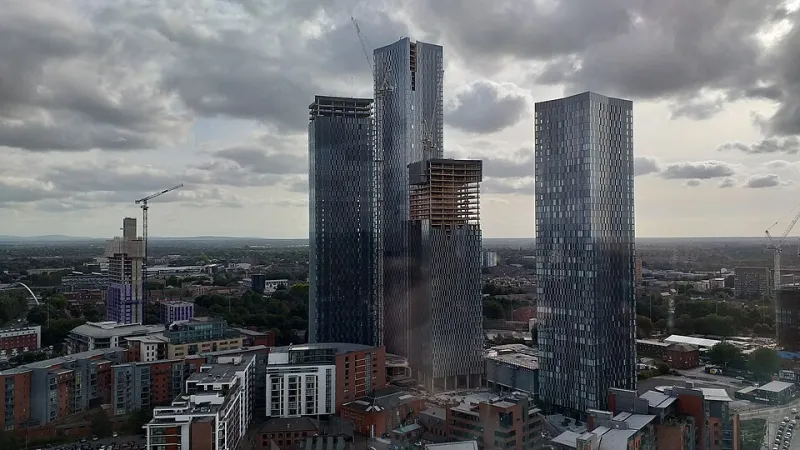
Photo: Ayman494, CC BY-SA 4.0, via Wikimedia Commons
Stand on the bridge over the Rochdale Canal in Ancoats and you can play a simple game: count the towers with cranes above them, then count the hoardings promising towers that have yet to break ground. In today's Manchester, the two lists are longer than at any point in the city's post-industrial history.
Greater Manchester's pipeline of buildings exceeding 20 storeys now runs to well over a hundred schemes, a concentration of vertical ambition unmatched anywhere in Britain outside the capital. But approvals are not apartments. The more interesting story lies in the geography of what is actually rising — and the clusters where the cranes have quietly moved on.
Deansgate Square: The Engine Room
No discussion of Manchester's skyline begins anywhere other than the Mancunian Way's southern flank. Deansgate Square — the four-tower ensemble by SimpsonHaugh that locals still call the Owen Street development — set the template in the mid-2010s: a consolidated site, an American-style podium, and towers stacked high enough to make a genuine dent in the skyline. At 201 metres, the tallest of the quartet remains the benchmark every subsequent scheme is measured against.
The area around it continues to densify. The continued build-out of the surrounding plots, alongside the nearby X1 and Embassy districts along Old Trafford Way and the Bridgewater Viad corridor, has created something approaching a genuine high-rise district rather than a scattering of towers. Planners privately acknowledge that Deansgate Square functions as the city's proof of concept: once a cluster reaches critical mass, each additional tower faces less resistance.
Ancoats and the New Islington Effect
Cross into Ancoats and the character changes. Here the towers are shorter, denser and more numerous, threaded between the mills and canals that gave the district its Conservation Area status. Schemes such as the Kampus development — a joint effort by Capital & Centric and Henry Boot — have shown how mid-rise and high-rise elements can sit alongside retained heritage without either losing the argument.
The tension is real, though. Applications pushing 30-plus storeys onto the fringes of the Ancoats and New Islington neighbourhoods have drawn sustained objections from civic groups, and Manchester City Council's own tall buildings guidance requires new towers to justify their height against the wider townscape rather than simply the size of the plot. Expect the next wave here to be a scatter of 20-to-30-storey residential slenders rather than another cluster of giants.
Greengate: Salford's Answer Across the Irwell
Walk two minutes north and you are in a different planning authority with a different ambition. Salford's Greengate district, hard against the River Irwell and the Victorian grandeur of Manchester Cathedral's rear elevation, has become the fastest-growing cluster in the conurbation. Tower after tower — several topping out above 35 storeys — has risen on former car parks and low-rise offices, stitching the Salford side of the river into the Manchester skyline so thoroughly that most observers cannot tell where one ends and the other begins.
Greengate matters for a simple reason: land assembly. Salford City Council was able to assemble large, clean sites in a way Manchester's tighter street grid rarely allows, and developers responded. The result is a skyline extension that will look substantially complete by the decade's end.
Has the Boom Peaked?
Ask three planners and you will get three answers. The optimists point to the sheer depth of the pipeline: even if a quarter of consented schemes lapse, the cranes will not leave the city before 2030. The pessimists note the warning signs — rising build costs, nervous institutional buyers, the collapse of several build-to-rent deals into renegotiation, and a handful of high-profile schemes stalled at foundation stage with remediation and fire-safety costs attached.
The likely truth is a consolidation rather than a collapse. The best-located, best-funded schemes — those in Deansgate Square, Greengate and the inner Ancoats belt — will complete. Marginal sites in outlying wards, particularly those reliant on small-apartment investor sales, are the ones most exposed. What Manchester ends up with by 2030 will be a skyline of two speeds: a dense, completed core that rivals any British city, and a ring of half-built ambitions waiting for the next cycle.
Either way, the floor-by-floor accounting continues. On current form, the cranes will be counting for some years yet.