The Vanishing Supertalls: Why London's Tallest Promises Keep Shrinking
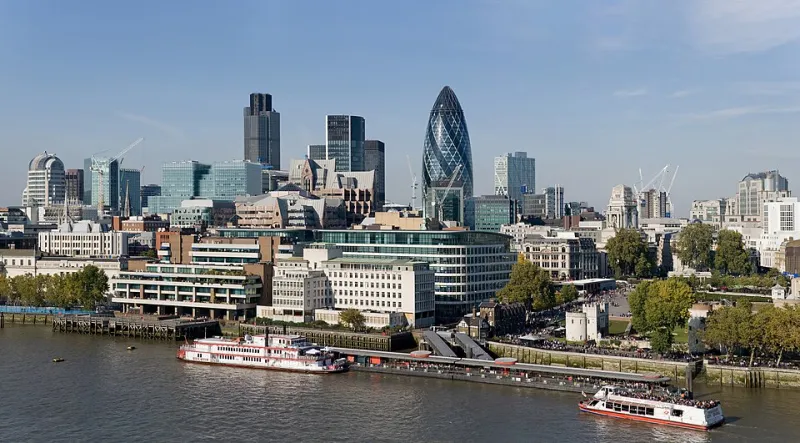
Photo: David Illif with image-alignment and Photoshoping by User:Colin and Kim Hansen, CC BY-SA 4.0, via Wikimedia Commons
There is a particular genre of London press release that Skyscraper News readers will recognise instantly. A celebrated architect, a render with the Shard looming politely in the background, and a height quoted in metres with suspicious precision. The tower is announced. It is approved. And then, more often than not, nothing happens.
This has been the defining pattern of London's high-rise decade: a city that has become exceptionally good at consenting tall buildings and strikingly poor at completing the ones that matter. The gap between the headline and the skyline has never been wider, and the forces closing it are not cyclical. They are structural.
The Square Mile's Paper Towers
The City of London deserves its own museum of unbuilt towers. Walk the Square Mile's planning maps and you will find consent after consent for 50, 60, even 70-storey schemes — a pipeline that, taken at face value, would give the capital a skyline to rival Frankfurt or Shenzhen. Taken at face value.
In practice, several of the most significant consents have sat in limbo for years. Some have been quietly redesigned downward; others have had their planning permissions expire or been shopped to different tenants with different needs. The City's own offices market tells you why: with post-pandemic vacancy rates stubbornly elevated and occupiers downsizing into fewer, better buildings, the commercial case for another speculative office supertall has weakened to the point of embarrassment. The towers being built — and, to be fair, several are — tend to be those pre-let to a single anchor tenant before construction begins. Everything else is a paper tower.
Vauxhall: Where the Heights Went Down
If the Square Mile illustrates the stalled tower, Vauxhall illustrates the shrinking one. The Nine Elms and Vauxhall Opportunity Area was masterplanned on an assumption of density — a corridor of tall buildings stretching from the power station to the river bend, with several schemes marketed at heights that would have redefined the south bank's silhouette.
What has actually been delivered is a different story. Consents have been revised. Heights have been trimmed, sometimes by a handful of storeys, sometimes by twenty. Some plots have been resold to developers who promptly submitted new applications for shorter, denser, more saleable buildings. The cluster exists — the river walk through Nine Elms is now genuinely high-rise in character — but it is a cluster of compromises, each planning committee meeting shaving a little more ambition off the original vision.
The Three Forces Shrinking the Skyline
Three pressures are doing the work. First, viability. Land in central London was bought at prices that assumed both sky-high sales values and construction costs that no longer exist. When the numbers are re-run, the answer is almost always the same: fewer floors, cheaper specification, or no scheme at all.
Second, the office glut. Every square foot of vacant 1990s stock is a square foot competing with a proposed tower, and institutional investors have grown cautious about committing to speculative commercial height.
Third — and least discussed — is the retrofit revolution. ESG mandates have made it fashionable, and increasingly necessary, to keep and upgrade existing buildings rather than demolish them. That is good news for embodied carbon and, arguably, for the capital's heritage. But it is bad news for new towers, because every office saved from the wrecking ball is a tower that does not get built. The economics of keeping now frequently beat the economics of rising, and capital flows accordingly.
What Should Happen Instead
None of this is an argument against tall buildings. It is an argument for honesty in the pipeline. Planning committees, developers and the press — this publication included — should be more sceptical about consented-but-unfunded schemes, and more willing to distinguish between a tower that will rise and a tower that exists to flatter a land valuation.
London's next supertall will get built eventually. But it will be built by a developer with a pre-let tenant, a viable land basis and a design that respects the new economics — not by the tallest render in the planning file. The capital's skyline ambitions are not dead; they are simply being recalibrated, storey by storey, in committee rooms most of us never see. Readers watching the cranes would do well to watch the spreadsheets too.