Decibel Districts: Reading Britain's Tower Sites Through the Ear Alone
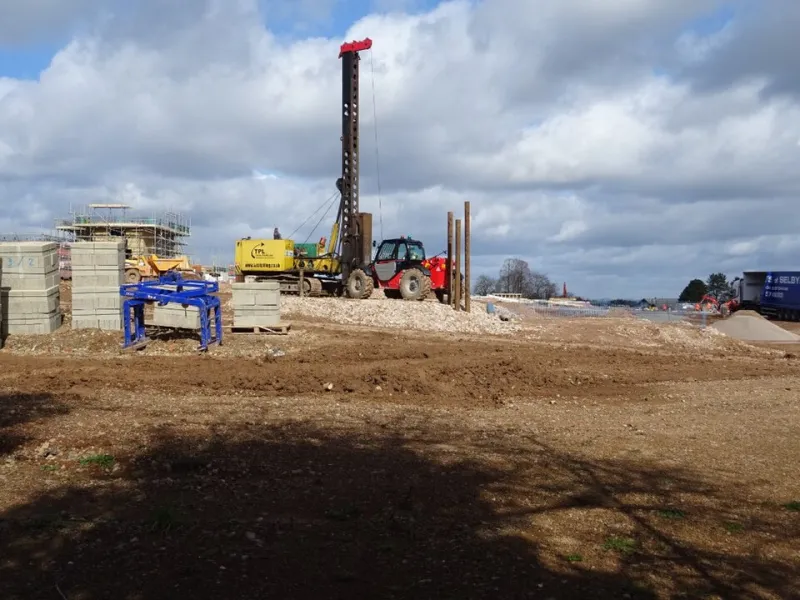
Photo: Philip Halling , CC BY-SA 2.0, via Wikimedia Commons
Stand at the hoarding of any major tower scheme in Britain — be it in Salford's Greengate cluster, along the Lea Valley, or beneath the cranes of Leeds' South Bank — close your eyes, and you can roughly tell how many storeys are in the ground. Not from a hoarding artist's impression, but from the noise. Construction acoustics are the least documented and most universally experienced aspect of tower delivery, and they deserve closer attention than the planning portals give them.
The Noise Envelope
Every consented tower in the UK carries conditions governing hours of work, and increasingly, explicit noise limits at the site boundary. Typical restrictions run from 8am to 6pm on weekdays for the noisiest operations, with respite provisions — agreed breaks in pile-driving, for instance — negotiated with the local authority's environmental health team. On congested urban plots, developers now routinely commission noise management plans as a condition of discharge before a single excavator arrives.
The measures are not cosmetic. In dense residential districts such as Nine Elms or Manchester's Ancoats, the receptor is often a tower already occupied and marketed on its quietness. A breach of the noise envelope is not merely a nuisance; it is a direct threat to the sales narrative of neighbouring schemes, which gives developers a commercial incentive that regulation alone rarely achieves.
A Listener's Guide to the Rising Frame
For those who live with a tower site as their neighbour, the soundscape follows a predictable sequence. Learning to read it is genuinely useful.
The percussive phase. Pile-driving is the loudest and most resented sound in the construction repertoire — a repetitive metallic concussion that carries for hundreds of metres. Where constraints demand, contractors turn to pressed or bored piling, which trades speed for near-silence. The shift from hammer to press is one of the quiet revolutions of British urban construction.
The excavation growl. Once piles are in, the tonal register drops: the diesel rumble of excavators, the reversing alarms (increasingly replaced by broadband white-noise alarms that are far less penetrating), and the rhythmic churn of concrete batching.
The pour. Night concrete pours on core-led towers — near-universal now that jump-form systems demand continuous work — produce a muffled, almost industrial lullaby: the hum of pumps, the squeal of vibrators compacting each lift. Residents rarely object to it once, because it is short, and it signals that the frame is climbing.
The clatter of the skin. Façade installation brings a lighter, higher-frequency register — the rattle of brackets, the whine of vacuum lifters manoeuvring precast panels or glazing units into place. When this sound dominates, the tower is in its final year.
Where Management Fails
Not every scheme gets this right. Complaints logged with councils in London and Birmingham point to recurring failures: monitoring equipment positioned to flatter the readings, out-of-hours working that creeps under the threshold of enforcement, and mitigation promised at committee but quietly value-engineered out. The gap between the acoustic commitments in a planning submission and the reality on the footway remains one of the under-examined frictions of Britain's building boom.
The best operators, by contrast, treat sound as a design material. Acoustic sheds around demolition, hoarding with absorptive linings, and delivery routing that keeps the loudest movements away from residential frontages are now standard among the major contractors on Britain's tallest schemes.
Why It Matters to the Skyline Watcher
Noise is the most democratic form of construction reporting. Residents cannot read a structural drawing, but they can hear a tower being born. For planners and developers alike, the lesson is simple: the soundscape of a site is part of its social licence, and the schemes that climb fastest and finish smoothest are usually those that took the ear as seriously as the eye.