Night Shift in the Sky: The Hidden Machinery of Britain's After-Hours Towers
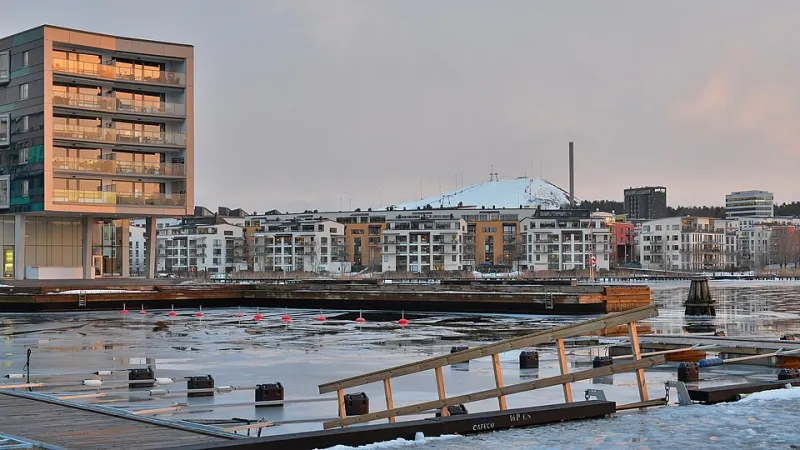
Photo: Arild Vågen, CC BY-SA 3.0, via Wikimedia Commons
By half past ten on a Tuesday evening, the concourse beneath a fifty-storey tower in Croydon has gone quiet. The residents' bar has closed, the last Amazon delivery has been logged, and the revolving door slows to the occasional late return. Upstairs, several hundred people are going to sleep. Downstairs, in a windowless room humming with switchgear and pipework, the building's real working day is only beginning.
For all the attention paid to cladding, cranes and crown heights, remarkably little is written about what happens inside a completed high-rise once the site office shuts. Yet it is in these hours that a tower either earns its running costs or quietly racks them up.
The Building That Never Sleeps
Every substantial residential tower in Britain now runs on a building management system — the BMS — a network of sensors and controllers that regulates everything from corridor temperature to pump duty cycles. During the day it operates largely in the background, yielding to the human traffic of residents, cleaners and maintenance crews. After midnight, it becomes the building's principal occupant.
"People assume the tower goes to sleep," says a chief engineer at a Leeds tower block who asked not to be named while his employer's energy contracts are under review. "It doesn't. It just changes shift. The BMS starts its night set-backs around eleven — dropping the heating loop by a degree or two, throttling the ventilation, switching the car park lighting to occupancy mode. If we get those curves right, we can shave thousands off the annual energy bill. If we get them wrong, we get complaints at six in the morning."
Those complaints travel fast in a vertical community. A stairwell that is two degrees too cold on floor thirty-eight generates an email before the kettle has boiled. The distance between comfort and grievance, engineers note, is measured in boiler flow temperatures.
The Human Layer: Porters, Patrols and the 3am Call
Machinery, however, is only half the story. Virtually every purpose-built residential tower above twenty storeys now staffs a night presence — a duty concierge, a security officer, or in older estates, a caretaker with a torch and a dog-eared logbook.
Their rounds are unglamorous and essential: testing fire doors, checking plant rooms for leaks, walking the podium deck where puddles form in exactly the same spot every winter. In towers served by a single core, the night porter is also the de facto first responder — the person who decides whether a smoke alarm on floor twenty-two is a burnt piece of toast or something worse.
"You develop a feel for the building at night," one Croydon duty manager told us. "You learn which floors run hot, which lift makes the odd noise, which resident comes home at four. The moment something deviates from that pattern, you notice. No sensor does that yet."
Dampers, District Heating and the Cost Nobody Sees
The financial weight of after-hours operation is where the industry's honest conversations happen. Britain's towers increasingly draw heat from district heating networks — communal boilers or energy centres pumping hot water through risers that serve every unit. These systems are efficient on paper and contentious in practice, with residents' bills often shaped less by their own behaviour than by the network's overnight losses and the operator's heat cost agreement.
Smoke control is another quiet expense. Pressurised stairwells, automatic dampers and smoke shaft fans must all be tested, logged and periodically exercised — usually at night, precisely because the systems cannot be taken out of service while residents are awake and mobile. A single damper fault discovered during a 2am test can trigger weeks of remedial work and a compliance paper trail that chief engineers describe, only half-jokingly, as their true full-time occupation.
Then there is the lift. Keeping at least one car running overnight — for emergencies, blue-light access and the resident arriving home from A&E — consumes standby power and, more importantly, dictates maintenance schedules. Vertical transport, as we have argued before, is the true test of whether a tower works; at night, it is also one of its largest standing costs.
What Developers Should Design For
The lesson from the people who run these buildings is consistent: operability is decided at design stage, not occupation stage. Plant rooms sized for maintenance access rather than mere compliance. Metering that lets residents see what communal services actually cost. BMS interfaces that a night porter can understand at three in the morning without an engineering degree.
Britain is adding high-rise homes at a pace not seen since the 1960s, and the towers rising in Manchester, Birmingham and Croydon will still be standing — and still be consuming — long after their developers have moved on. The skyline gets the photographs. But the measure of a good tower, the night shift will tell you, is written in the logbooks: the building that runs warm, lit and safe at four in the morning, and nobody outside the plant room ever notices.