Desk Meets Duplex: Auditing the Rise of Britain's Vertical Live-Work Towers
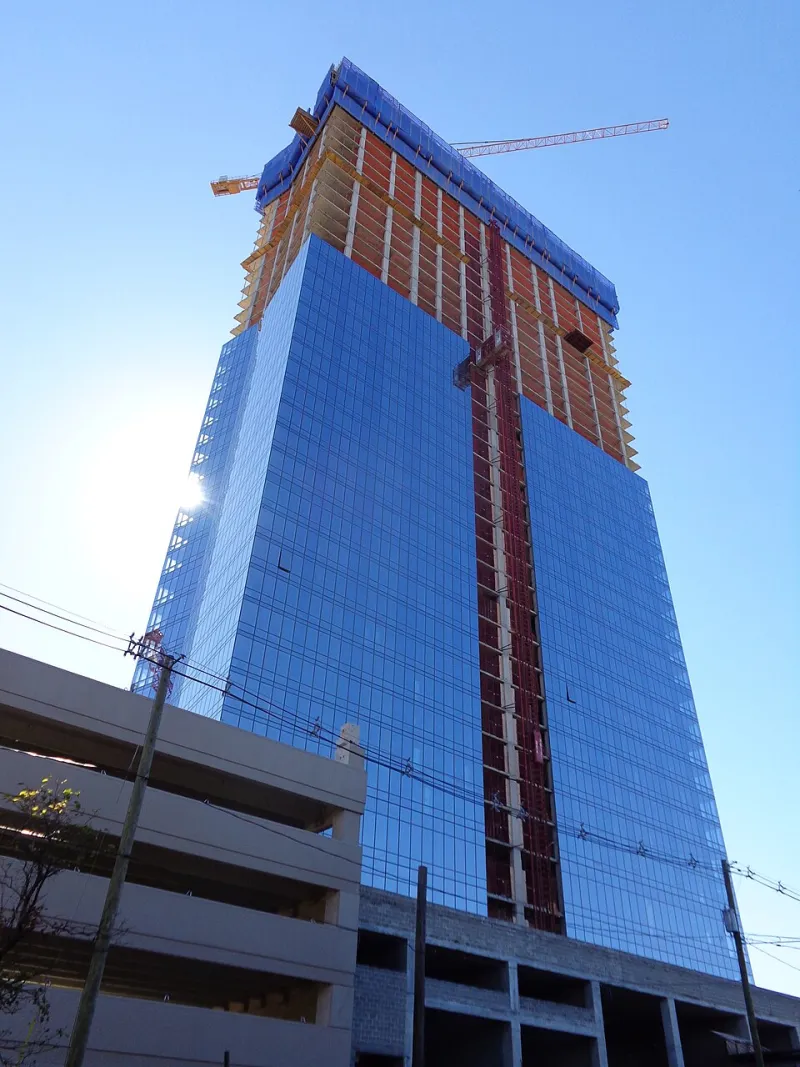
Photo: Hudconja, CC BY-SA 3.0, via Wikimedia Commons
The marketing brochure for a new residential tower used to be a simple document: penthouse finishes, river views, a residents' gym. Increasingly, a second page has been inserted — the business floor. Co-working lounges on level two, bookable meeting rooms on level twelve, 'innovation suites' tucked beneath the plant decks. Britain's towers are learning to work as well as sleep, and the change is more structural than cosmetic.
From Amenity to Infrastructure
The earliest co-working spaces in residential schemes were treated as amenities, in the same bracket as the cinema room and the golf simulator. What has shifted over the past three years is the seriousness of the provision. Developers in Manchester's Deansgate Square cluster and Birmingham's expanding Jewellery Quarter skyline now routinely commit to dedicated business floors as a condition of securing consent for greater height.
Planners, in short, have discovered a trade. A tower that can demonstrate employment space on its lower and middle levels is an easier sell at committee than a monolith of pure residential. In practice, this means a resident of a sixty-storey tower can hold a company registered address, meet clients in the lobby café and never leave the building between the school run and the last video call.
The Two-Minute Commute, Tested
The theory is seductive; the practice deserves scrutiny. Speak to residents who have genuinely built businesses inside these towers and a more textured picture emerges.
A design consultant operating from a Manchester tower describes the arrangement as 'brilliant for focus, punishing for serendipity'. The co-working lounge two floors below her flat has replaced the tram commute she once endured to a Spinningfields office, but she misses the accidental encounters that a larger office floor provides. Her workaround: deliberately booking desks in a shared workspace across the city one day a week, preserving the professional network that pure home-working erodes.
In Birmingham, a fintech founder running a five-person team from a business floor in a tower off Broad Street reports the opposite problem. His neighbours in the residents' lift are also his colleagues' neighbours, and the boundary between the two has dissolved entirely. 'The lift is the commute, the corridor is the office, and the flat is the break room,' he notes. 'You have to invent your own edge to the working day.'
What the Planning Files Show
A trawl through recent committee papers reveals how thoroughly the live-work provision has been normalised. Mixed-use height agreements — once the preserve of landmark schemes — now appear as standard drafting in Section 106 negotiations across the core cities. Salford, Leeds and Bristol have all approved residential towers in the past year where employment floors were material considerations in granting the additional storeys.
The economics are not always comfortable. Business floors in residential towers carry higher fit-out costs per square foot than residential space, and the occupier market for small-suite offices is cyclical. Several schemes have quietly converted unlet commercial floors to apartments within five years of completion — a pattern that suggests the live-work tower is still proving itself.
The Verdict From the Ground and the Thirtieth Floor
Vertical live-work living is not a gimmick, but neither is it a settled model. Where it works — and the evidence from Manchester and Birmingham suggests it can — is where the business space is treated as genuine infrastructure: proper acoustics, separate lift access, meeting rooms that a client would not be embarrassed to enter.
Where it fails is when the co-working lounge is a handful of desks beside the bin store, included to tick a mixed-use box. Residents can tell the difference, and so, increasingly, can the planning officers drafting the height agreements.
Britain's towers have always been buildings of ambition. The next chapter of that ambition appears to be written not in the penthouse but on the business floor — and whether it amounts to a genuine transformation of how we live and work, or merely a line in the brochure, will be decided floor by floor over the coming decade.